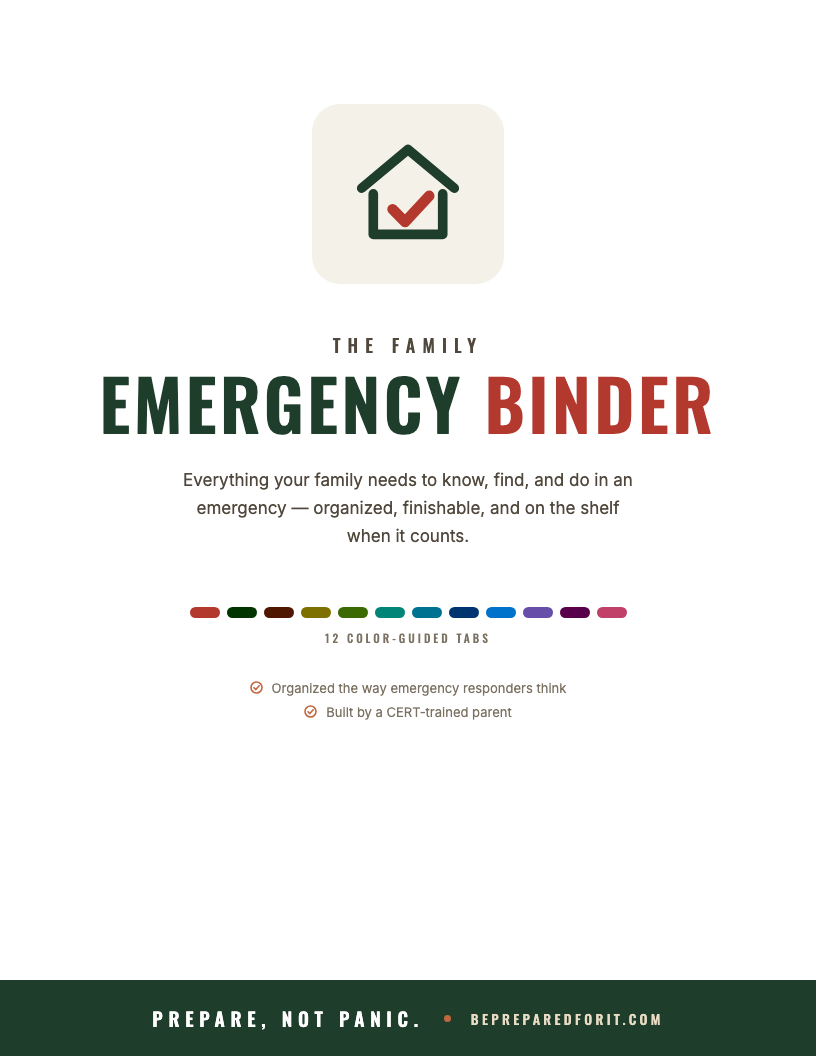
The Family Emergency Binder
Every contact, document, medication, and account your family would need in a crisis, organized the way emergency responders think. Nothing in here is homework: the quick setup gets the essentials done tonight, and the rest waits for whenever you're ready.
Instant download. Fillable PDF, made for free Adobe Acrobat Reader.
An emergency binder is one organized place for the contacts, documents, medical details, and financial information a household would need during a crisis or after a death. A good one records where each original is kept rather than the account numbers themselves, so a lost binder exposes far less.
Your insurance policy is in an email you'd have to search for. The pediatrician's number is in your phone, which might be dead or missing. Your kid's allergy list is something you just remember. The Wi-Fi password, the gas shutoff location, where the birth certificates are, who has a spare key. It's all real. It's all somewhere. And most of it lives in one parent's head.
That works fine on a normal Tuesday. It doesn't work when the power's out, you're evacuating in twenty minutes, or someone else has to step in and you're not there to answer questions. It also doesn't work if something happens to you: a spouse or adult child settling your affairs shouldn't have to guess where the will is or spend three weeks locked out of your email.
The Family Emergency Binder gets it all out of your head and your inbox and onto paper (or a filled-in PDF) that anyone in your family can pick up and use, tonight or years from now.
What's inside
Start Here opens the binder with the 15-minute quick setup and the 3-day build plan. Then 12 color-coded sections, red one first.
Grab this one first
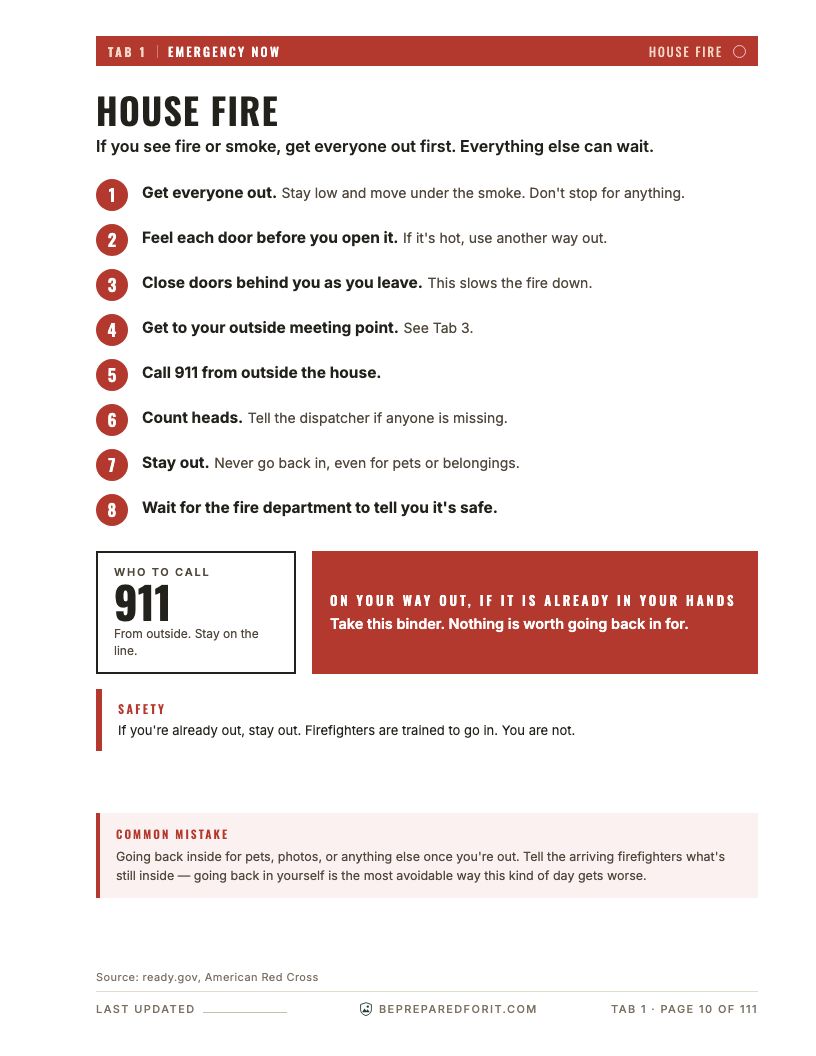
The one tab you grab first. First-10-minutes steps for eight emergencies: house fire, medical emergency, evacuation order, shelter in place, power outage, gas leak, earthquake, and flash flood. Plus your fire escape plan and grab list.
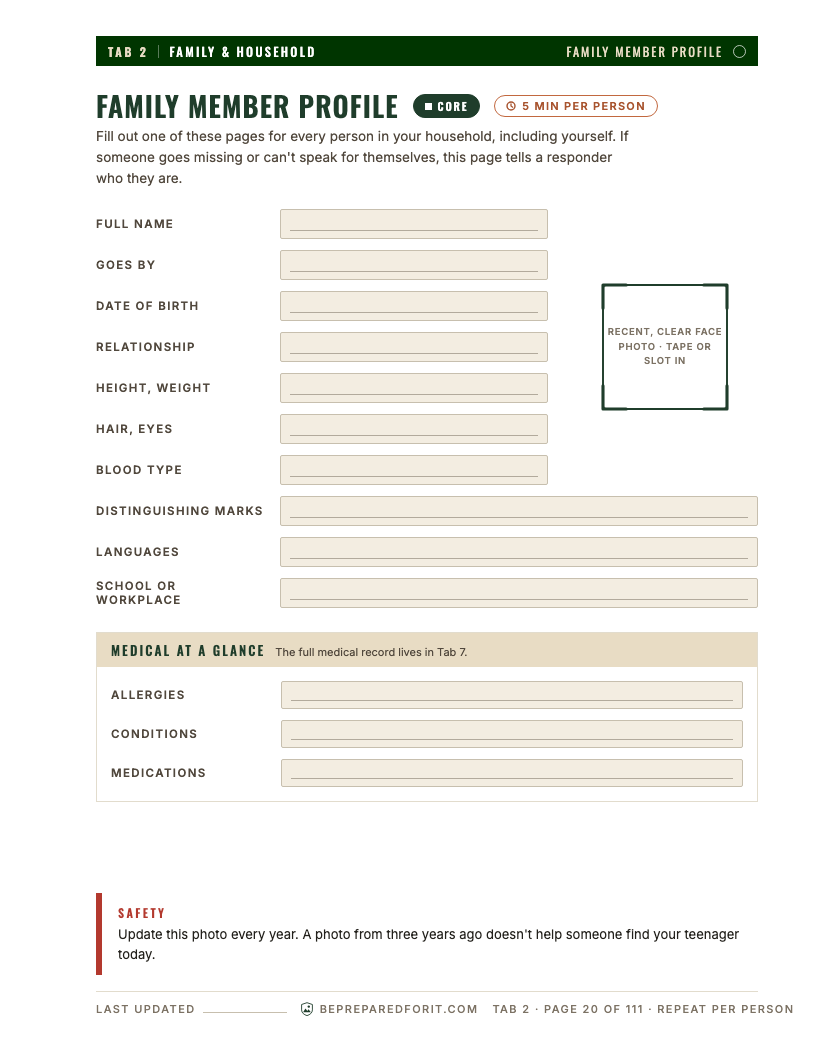
A profile for every person (and pet) in your house: medical conditions, medications, allergies, school and pickup info, care notes for kids or elderly family members.
ICE contacts, your out-of-area check-in person, and where everyone meets if you get separated.
A locator for every vital record: where the original is, where the copy is, what's digital. No more searching for the passport when you need it in ten minutes.
Every policy and account, at a glance: carrier, contact, what it covers. (We never ask for account numbers or passwords. More on that below.)
Utility shutoffs with a spot to tape in a photo, home inventory starter, warranties, and who to call for repairs.
Doctors, prescriptions, vaccination records, and medical history for everyone in the house, in one place a babysitter or grandparent could actually use.
Where your password manager is and who has emergency access. Never the passwords themselves.
Go-bag checklists built for adults, kids, babies, and pets, plus what to keep in the car.
A locator for your will, power of attorney, and attorney contact, and a page of conversations worth having now instead of later.
A 10-minute seasonal checklist so the binder stays current instead of becoming another thing you filled out once and forgot.
Wallet ICE cards, a fridge sheet, a sitter one-pager, spine and cover inserts, and spare pages for extra kids, pets, and go-bags.
Extras included
Wallet-size ICE cards for each family member, a fridge sheet for babysitters and guests, a one-page babysitter/caregiver cheat sheet, and binder spine and cover inserts.
Why this one's different
Flip to the red Emergency Now tab and you get first-10-minutes steps, not a blank form. A lot of binders are built to hold information. This one is built to be used in the first ten minutes of a bad day.
The order isn't random. Life safety comes first, then communication, then documents, then recovery. CERT training drills the same first rule: protect lives before anything else. So the binder makes sense under stress, not just on a calm Sunday.
This isn't a Word doc with a stock-photo cover. It's 100+ pages built with the same calm, considered design system as the rest of the site. It's something you'd leave on the shelf, not shove in a drawer.
The title page has an update log, and Section 11 gives you a 10-minute seasonal review four times a year plus a change log, so the binder still matches your life a year from now, not just the week you bought it.
Also built for after
Not everyone opens this binder during a crisis. Some open it afterward: a parent has died, and someone has to find the will, get into the accounts, and call the right people, all while grieving.
This isn't a will or a substitute for legal advice. If you don't have a will yet, that's worth a call to a local attorney, not a form in this binder. Sections 4 and 10 just make sure whatever you do have is findable.
Why I built this
I'm a parent, and I'm CERT-trained. That's the FEMA-backed community emergency response course, usually taught by local fire departments. The thing that training drills into you is that the first few minutes matter, and families with their information written down get through them calmer and faster. Meanwhile, half my own family's critical information lived in my head and the rest was scattered across old emails nobody could find under pressure. So I built the binder I wanted on my own shelf: organized the way responders think, honest about what should never be written down, and simple enough that anyone in the house can use it. This is that binder.
The safety line we hold
Plenty of binder templates ask you to write passwords and account numbers on a printed page that can be lost, borrowed, or found by the wrong person. This one doesn't. A binder full of your family's information should make you feel more secure, not less. So there are hard lines:
Instead, the binder uses a locator system: where the password manager is, who has emergency access, which drawer the safe deposit key is in, which institution holds which account. It tells whoever's reading it where to find the real thing and who can get to it, so a lost or borrowed binder gives away far less than one full of passwords and account numbers.
One more thing worth knowing. The federal government's own emergency checklist (FEMA's Emergency Financial First Aid Kit) asks you to write full account and routing numbers into its forms. Ours never will.
Be Prepared For It is independent. We aren't affiliated with or endorsed by FEMA, CDC, Ready.gov, or the CERT program; we check our pages against their published guidance.
What you get
How it works
See it before you buy it
Final printed pages may differ slightly.
The cover
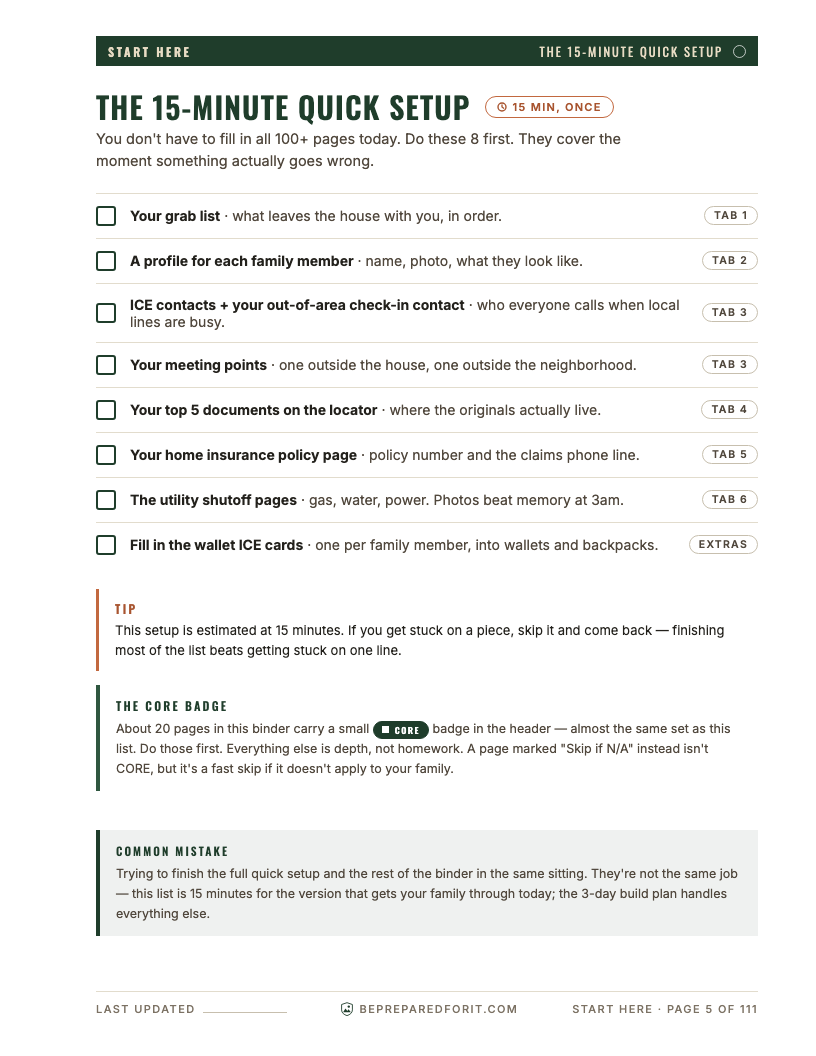
15-minute quick setup
House fire, Section 1
Family member profile, Section 2
Launch price
$19during launch week, then $39
Less than a family takeout order, and it covers what actually matters if you ever need it.
Join the list, get it for $19Instant download. Fillable PDF, made for free Adobe Acrobat Reader.
30-day full refund, no questions asked. Refund terms
One thing to do
The binder is in final production and is coming soon. Join the list and get it for $19 during launch week. Your launch email carries the code.
The whole system
$19during launch week, then $39
All 12 tabs, both editions, every extra. The 15-minute quick setup covers the essentials on day one; the 3-day plan finishes the rest.
Join the list, get it for $19See the gear the binder mentions
Yes. It's a digital download. You'll have the file within a minute or two of checkout, no shipping, no waiting.
No. The type-in edition is built for free Adobe Acrobat Reader on Mac or PC. Type into the fields, use Save As, and reopen it once to check your answers stuck. Prefer pen and paper? The print-blank edition is in the same download.
The quick setup covers four essentials, one entry each, in about 15 minutes. That gets your family covered on day one. The rest of the binder follows a 3-day plan. Do it three days in a row or one day a weekend for three weekends, whatever doesn't feel like homework.
The binder is designed with that exact concern in mind. It never asks for full passwords, full Social Security numbers, PINs, or full account numbers. It records where those things are and who can get to them. It still holds personal details and ID copies, so treat it like your passport: keep it somewhere safe that your family knows about, and give a sitter the one-page sitter sheet instead.
Any home printer or local print shop works. It's formatted for standard US Letter paper. Regular printer paper is fine; if you want it to hold up to years of handling, a print shop can laminate the most-used pages (Emergency Now and the ICE cards) for a few dollars more.
No. This is for regular families who want their information organized before they need it, not people building bunkers. There's no doomsday talk in here. Just the practical stuff every household deals with: outages, evacuation orders, a trip to the ER, a babysitter who needs the pediatrician's number fast.
The fillable PDF is yours to edit anytime in your PDF reader. Section 11 includes a seasonal review checklist and a change log built specifically for keeping it current as your family's information changes.
You get 30 days from purchase to ask for a full refund on the binder, no questions asked. Reply to your receipt email or use the contact page and we'll refund you. The full terms are on the terms of service page.
Fifteen minutes gets the essentials covered. Three days, at your own pace, gets the whole thing done. Get it while things are calm, so it's already done when they're not.
Most families build this the week a storm's already in the forecast, when the shelves are empty and nobody's calm. Do it now, on a quiet night, instead.
Join the list, get it for $19Instant download. Fillable PDF and print-blank edition, both included.
The Family Emergency Binder, $19 during launch week
Get itComing soon
The Family Emergency Binder is coming soon. Join the list and get it for $19 during launch week. Your launch email carries the code. After launch week the price is $39.
One email when it launches. Unsubscribe anytime.